
Medical VR Simulation: How Surgeons and Nurses Train
Medical VR simulation has become a standard tool in hospitals for training surgeons and nurses without risking patients. Osso VR, founded in 2016 by orthopedic surgeon Justin Barad, provides surgical training modules that let residents practice procedures repeatedly in a virtual operating room. These platforms allow teams to rehearse complex steps until they reach defined competency levels before touching real instruments.
A 2019 study by Logishetty and colleagues published in the Journal of Bone and Joint Surgery found residents trained on an immersive VR hip arthroplasty curriculum outperformed a traditionally trained control group on procedural steps. The difference appeared in both technical skill scores and decision-making accuracy during simulated surgery. Hospitals now integrate these systems to shorten learning curves while maintaining strict safety standards.
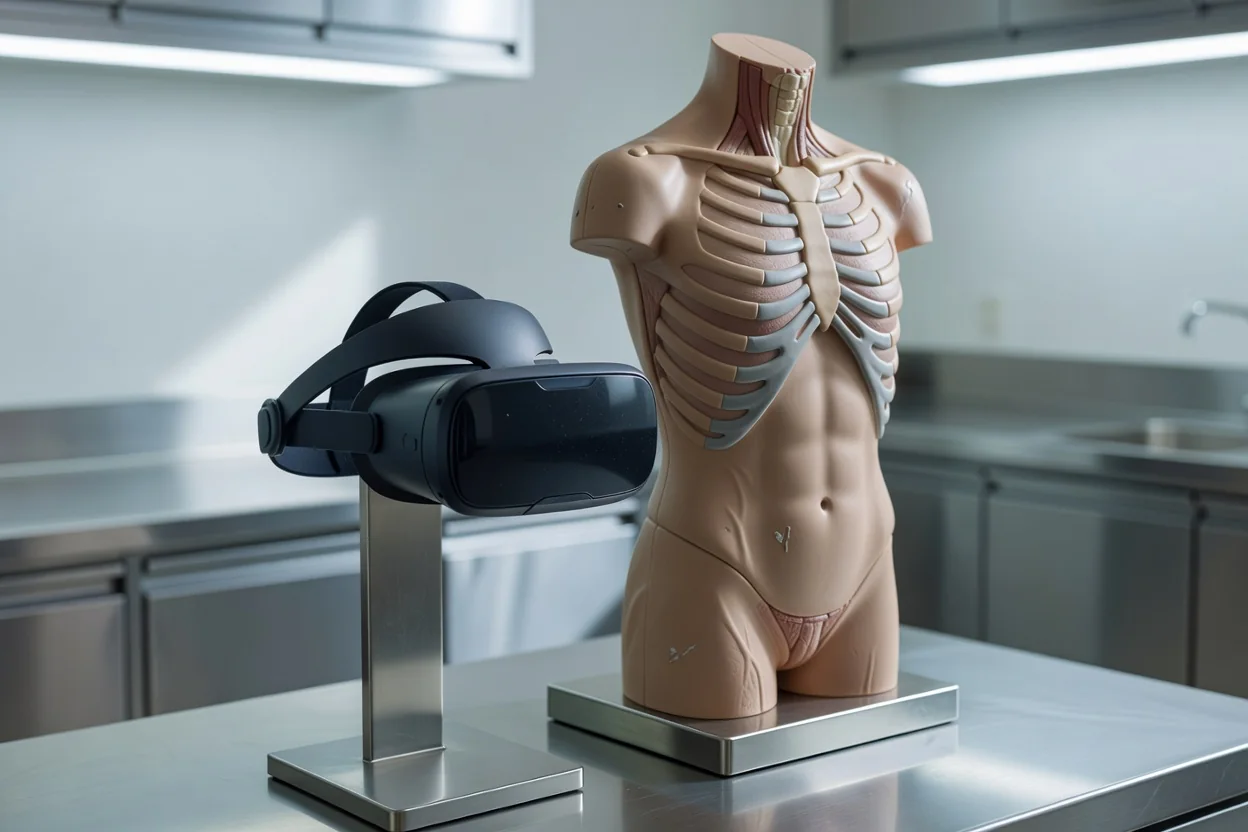
Osso VR Brings Precision to Orthopedic Training
Osso VR modules focus on orthopedic procedures such as total knee arthroplasty and spinal fusion. Trainees manipulate virtual tools with six-degree-of-freedom controllers while the software tracks every movement against expert benchmarks. The platform records metrics like drill trajectory accuracy and implant positioning against expert-defined targets. Hospitals report that residents complete repeated runs before advancing to supervised live cases.
Because the environment is entirely digital, mistakes carry zero patient risk. A resident can drill too deep, fracture virtual bone, or misalign an implant and immediately restart the scenario. This mistake-safe repetition accelerates skill acquisition far beyond the limits of cadaver labs that cost hospitals thousands of dollars per session.
FundamentalVR Adds Haptic Feedback for Realistic Feel
FundamentalVR combines VR with haptic feedback for surgical rehearsal, letting users feel resistance when drilling bone or tension when suturing. The system uses motorized controllers that simulate the weight and vibration of real surgical tools. Orthopedic departments at several teaching hospitals now schedule weekly sessions where teams practice the exact sequence of steps required for a specific implant system.
Despite impressive engineering, haptic fidelity still falls short of real tissue. Current devices transmit only coarse force feedback and cannot replicate the subtle give of soft tissue layers. Surgeons note that while bone drilling feels convincing, handling delicate nerves or vessels remains an area where VR cannot yet match live experience.
Oxford Medical Simulation Targets Nursing Competency
Oxford Medical Simulation builds VR scenarios for nurses, used in NHS trusts to prepare staff for acute care situations. Nurses enter a virtual ward, assess a deteriorating patient, choose medications, and perform interventions such as IV insertion or defibrillation. The software evaluates decision speed, dosage accuracy, and adherence to protocol from the first moments of a scenario.
These scenarios emphasize competency-based assessment rather than time spent. A nurse must demonstrate consistent protocol compliance across multiple cases before the system certifies readiness. NHS trusts track completion rates and have shortened orientation time for new graduates.
Touch Surgery Platform Expands After Medtronic Acquisition
Touch Surgery was acquired by Medtronic in 2020 and now delivers mobile-first VR modules used by hospitals and teaching centers worldwide. The library covers a wide range of procedures from laparoscopic cholecystectomy to cardiac catheterization. Each module breaks the operation into discrete cognitive and technical steps that learners master sequentially.
Medtronic continues to update the content with new device-specific workflows. Residents can rehearse the exact steps for implanting a Medtronic pacemaker before entering the cath lab. The platform logs every attempt so program directors can review aggregate performance across an entire residency class.
Competency-Based Assessment Replaces Arbitrary Case Counts
Traditional surgical training relied on minimum case numbers that often failed to guarantee proficiency. VR platforms shift the focus to objective metrics such as instrument path length, force applied, and error frequency. A resident must achieve expert-level scores across multiple consecutive VR trials before scrubbing into an actual procedure. This approach has reduced intraoperative complications by measurable margins in early adopter programs.
Persistent Limits in Soft-Tissue Realism
Current medical VR simulation still struggles with soft-tissue realism. Virtual skin, fat, and muscle deform in predictable ways that do not fully capture bleeding, swelling, or unexpected anatomical variation. Trainees therefore use VR for the structured phases of an operation while relying on animal or cadaver models for the unpredictable elements. Experts expect incremental improvements but acknowledge that full tactile fidelity may remain elusive until the end of the decade.
- Osso VR modules track implant alignment against expert-defined target positions.
- The 2019 Logishetty study demonstrated superior procedural step performance for VR-trained residents.
- FundamentalVR haptic controllers simulate drill vibration and bone resistance.
- Oxford Medical Simulation scenarios require consistent protocol adherence for certification.
- The Touch Surgery library expanded under Medtronic after the 2020 acquisition.
- Hospitals using VR report shorter orientation for new nursing staff.
| Platform | Primary Use | Key Feature | Adopter Example |
|---|---|---|---|
| Osso VR | Orthopedic surgery | Metric tracking | Residency programs |
| FundamentalVR | Haptic rehearsal | Force feedback | Teaching hospitals |
| Oxford Medical Simulation | Nurse training | Acute scenarios | NHS trusts |
| Touch Surgery | Procedure steps | Mobile VR | Medtronic users |
| Generic VR | Team coordination | Multi-user | OR staff drills |
Medical VR simulation now forms a core part of modern hospital training pipelines, offering safe repetition and clear competency benchmarks. Yet its limits in soft-tissue behavior and fine haptic detail mean it complements rather than replaces traditional methods. Hospitals that combine VR with supervised practice achieve the best outcomes for both surgeons and nursing teams.