Eye Tracking in VR: What It Actually Unlocks
Eye tracking in virtual reality headsets has moved from experimental add-on to core feature in flagship devices. PlayStation VR2, released in 2023, ships with built-in eye tracking that powers both foveated rendering and direct gaze input for menus and selections. Meta Quest Pro, launched in October 2022 at 1,499 dollars, includes eye and face tracking hardware from Tobii. These systems open practical capabilities that go well beyond flashy marketing demonstrations.
Apple Vision Pro, which reached customers in February 2024, relies on eye tracking as its primary pointer, letting users select, scroll, and navigate simply by looking. HTC Vive Pro Eye, introduced in 2019, targeted enterprise customers who wanted gaze analytics to measure attention and cognitive load. The technology, supplied by Tobii to multiple headset makers, quietly changes how VR hardware renders images, how interfaces respond, and how user behavior can be studied. Yet it also surfaces serious privacy questions that companies have only begun to address.
How Foveated Rendering Actually Works
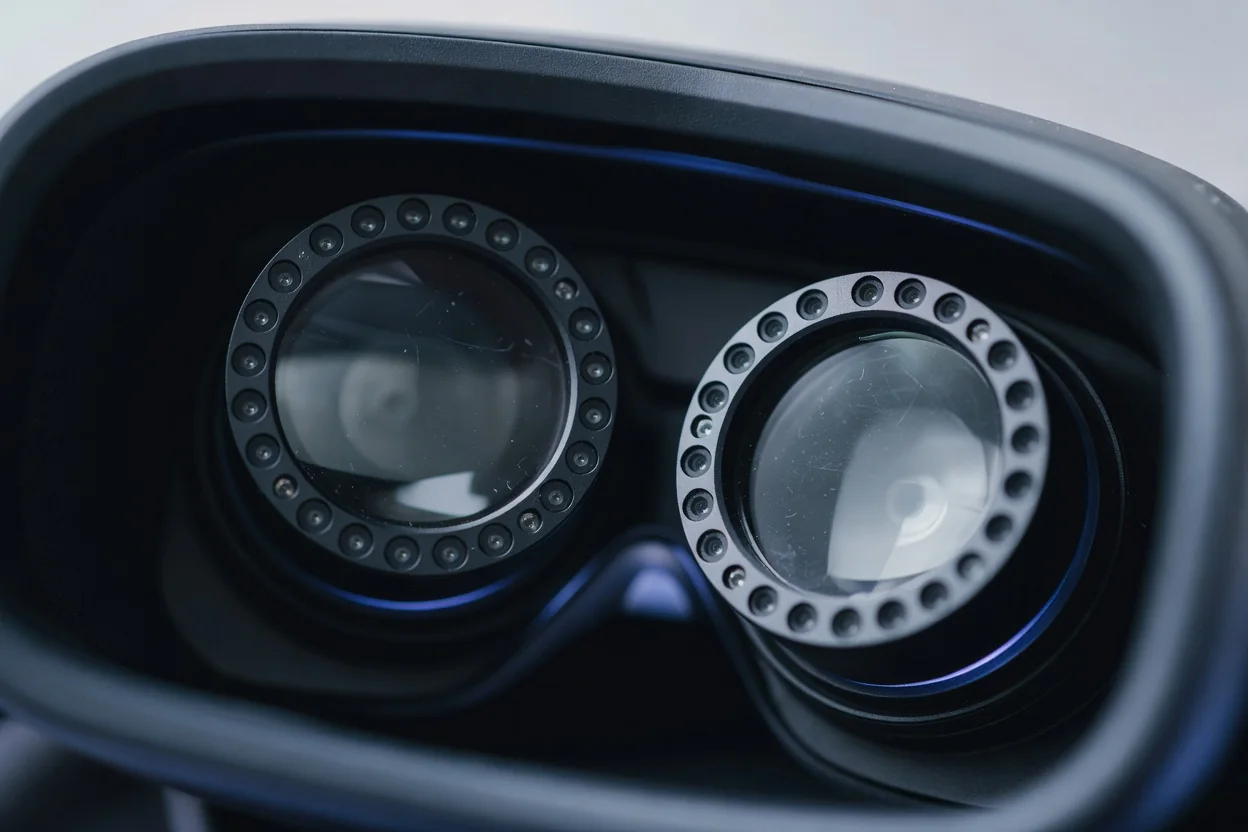
Foveated rendering exploits a basic fact about human vision: the fovea, the small central part of the retina, sees sharp detail while peripheral vision is blurry. Headsets like PlayStation VR2 and Meta Quest Pro render full resolution only in the tiny area where the user is looking and drop quality dramatically in the periphery. The result is a sharp image that feels native to human sight while the GPU workload shrinks by 30 to 50 percent in many scenes. Tobii’s hardware inside these devices reports gaze position 90 to 120 times per second so the rendering engine can recenter the high-detail zone in real time.
Gaze Input as a Primary Interface
Apple Vision Pro treats eye tracking as the main pointing device. Users look at a virtual button or slider and pinch their fingers to activate it. The system combines gaze with subtle hand gestures so the interface feels direct and almost telepathic. Meta Quest Pro offers a similar option for hands-free menu navigation when users wear the headset without controllers. In both cases the latency between eye movement and cursor update must stay under 20 milliseconds or the experience collapses into nausea.
PlayStation VR2 uses gaze input more selectively. Players can select dialogue options or recenter the view by looking, but core locomotion still relies on thumbsticks. The difference highlights a design choice: gaze works best for discrete selections rather than continuous analog control. Tobii’s calibration routine, which asks users to follow a moving dot for 15 seconds, remains mandatory on every device before first use.
Gaze Analytics in Enterprise and Research
HTC Vive Pro Eye was built for companies that want to quantify where trainees look during safety simulations. Heat maps of gaze paths reveal whether an operator checked the correct gauge before flipping a switch. Retail researchers use the same data inside virtual store mockups to measure how long shoppers dwell on product packaging or whether they notice price tags. These analytics packages log fixation duration, saccade speed, and pupil dilation, feeding dashboards that training managers review after each session.
The value is real, yet the data is intensely personal. A single training session on a headset like the Meta Quest Pro can generate hundreds of thousands of gaze vectors. Enterprises must decide whether that information stays on the device or travels to cloud servers. Tobii provides enterprise-grade SDKs that let customers choose local-only processing, but many organizations still default to cloud upload for easier reporting.
Accessibility Benefits and Limitations
Eye tracking creates new input channels for users who cannot reliably use hand controllers. People with limited upper-body mobility can navigate menus, type on virtual keyboards, or steer avatars simply by looking. Apple Vision Pro demonstrated this capability during its launch events, showing users with motor impairments composing emails using only gaze and dwell time. Meta Quest Pro added similar dwell-based selection in its accessibility menu in late 2023.
Accuracy varies with corrective lenses and eye shape. Users with strong prescriptions sometimes need an extra 10-second recalibration after swapping glasses. Fatigue also matters. After long continuous sessions, some users report that gaze tracking drifts enough to miss small UI targets. Developers therefore combine gaze with voice commands or head gestures as fallback methods.
Privacy Risks of Gaze Data
Gaze patterns can reveal medical conditions, emotional states, and even cognitive impairment before the user is consciously aware. A sudden increase in fixation time on bright colors might indicate early attention fatigue. Pupil dilation data collected by HTC Vive Pro Eye or Meta Quest Pro can expose stress levels or sexual arousal with uncomfortable accuracy. Companies have not yet published comprehensive policies on how long gaze logs are retained or who can request them.
Apple Vision Pro processes most eye data on-device and claims never to send raw vectors to its servers. Regulators in Europe have started asking whether gaze information qualifies as biometric data under GDPR. Until clearer standards emerge, users must weigh the convenience of gaze input against the permanent record their eyes might create inside corporate or cloud systems.
- Foveated rendering reduces GPU load by rendering full detail only where the user looks.
- Apple Vision Pro uses eye tracking as the default pointer instead of a handheld controller.
- HTC Vive Pro Eye delivers gaze analytics for enterprise training and retail studies.
- Tobii supplies the core eye-tracking modules found in Meta Quest Pro and PlayStation VR2.
- Gaze data can expose stress, fatigue, and medical conditions that users may not intend to share.
- Calibration routines take 10 to 20 seconds but must be repeated when glasses change.
| Headset | Launch Year | Eye Tracking Use | Price (US dollars) |
|---|---|---|---|
| HTC Vive Pro Eye | 2019 | Gaze analytics | 1,599 |
| Meta Quest Pro | 2022 | Foveation + input | 1,499 |
| PlayStation VR2 | 2023 | Foveation + selection | 549 |
| Apple Vision Pro | 2024 | Primary pointer | 3,499 |
Eye tracking is no longer optional in premium VR hardware. It delivers measurable performance gains and new interaction models, yet the privacy implications remain unresolved. Users and enterprises will need clearer data policies before the technology can be adopted without hesitation.