Standalone vs PC VR: How to Choose in 2026
Business technology buyers in 2026 face a clear fork in the road when selecting virtual reality hardware: standalone headsets that run untethered or PC-tethered systems that leverage high-end graphics cards. The Meta Quest 3, launched in October 2023 at 499.99 US dollars, brought powerful onboard processing to the mainstream, while the older Quest 2, launched in October 2020 at 299 dollars and later cut to 199 dollars in 2024, remains a low-cost entry point. On the tethered side, the Valve Index shipped from June 2019 as a 999-dollar full kit, and the PlayStation VR2 launched in February 2023 at 549.99 dollars, each promising superior visual fidelity when paired with a capable PC.
Wireless PC streaming options such as Meta Air Link from 2021 or the Virtual Desktop app running over Wi-Fi 6E have narrowed the practical gap between the two categories. Yet differences in tracking precision, GPU headroom, deployment scale, hygiene protocols, and total cost of ownership remain decisive for enterprise deployments. Choosing correctly can save thousands per seat while avoiding workflow friction that derails training or design reviews.
Tracking Performance and Inside-Out vs External Sensors
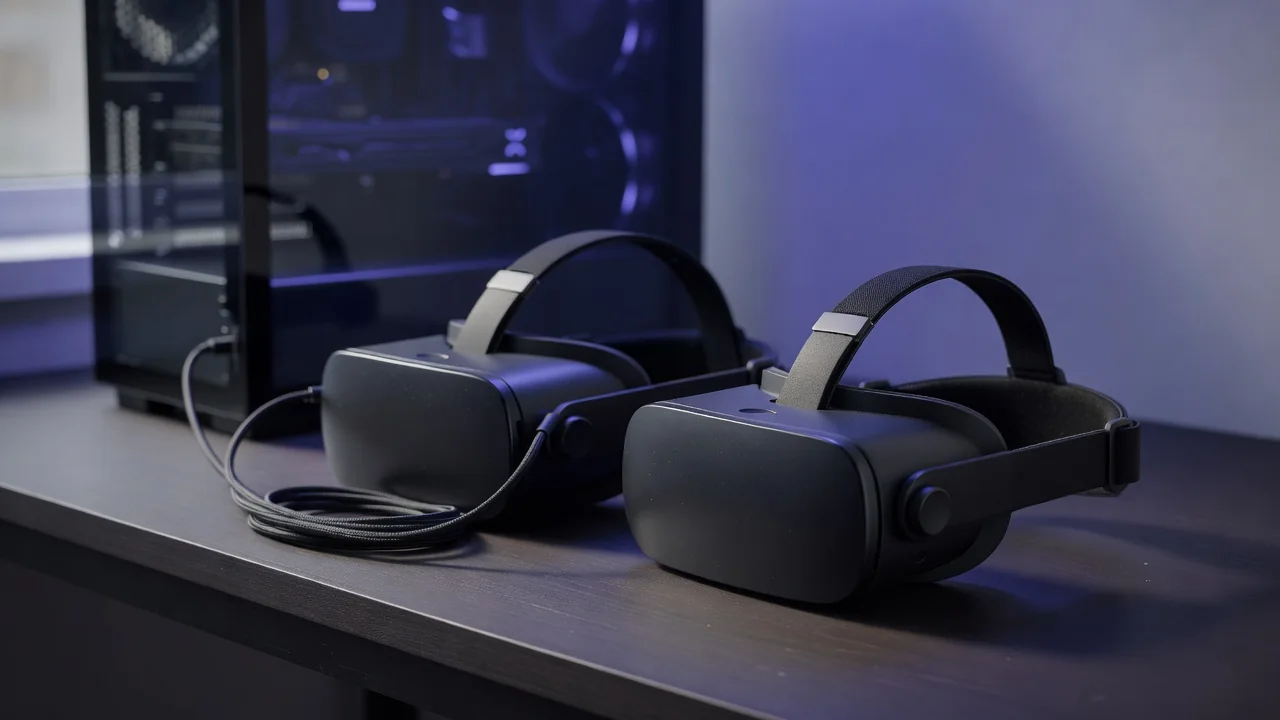
Standalone headsets like the Meta Quest 3 and HTC Vive Focus 3 from 2021 rely on inside-out cameras for six-degree-of-freedom tracking. These systems deliver reliable performance in well-lit offices measuring up to 20 by 20 feet, yet they can lose precision near reflective surfaces or in very dim rooms. The PICO 4 from 2022 improved edge cases with better camera placement, but still trails external lighthouse systems used by the Valve Index since June 2019.
Tethered kits maintain sub-millimeter accuracy across larger play areas when base stations are correctly positioned. For architectural walkthroughs or precise assembly training, this difference of roughly 0.5 millimeters can matter. Most businesses accept the standalone compromise because the convenience outweighs the marginal tracking loss in most typical enterprise scenarios.
GPU Headroom and Visual Fidelity Limits
PC-tethered VR headsets tap directly into discrete graphics cards, giving the Valve Index and PlayStation VR2 far higher rendering budgets and refresh rates when paired with a modern GPU such as the RTX 4090. Standalone devices such as the Meta Quest 3 must compress rendering to fit within their mobile chipsets, resulting in noticeable reductions in texture detail and anti-aliasing quality. Wireless streaming via Virtual Desktop over Wi-Fi 6E can deliver 90-hertz PC visuals but introduces 15 to 30 milliseconds of additional latency.
That latency gap shrinks yearly, yet remains measurable during fast head movements. Enterprises running CAD visualization or medical simulation often retain tethered systems for the extra GPU headroom, accepting cables in exchange for pixel-perfect renders that standalone units cannot match even in 2026.
Deployment Scale and Management Overhead
Standalone headsets scale far more easily across dozens or hundreds of users. The Meta Quest 3 and PICO 4 support centralized device management through enterprise accounts, allowing IT teams to push updates and restrict applications without touching each unit. Deploying 50 Valve Index kits, however, requires matching PCs with adequate cooling and power, driving up both space and support tickets. HTC Vive Focus 3 units from 2021 were designed specifically for this business reality, with robust fleet tools built in from day one.
Hygiene and Shared-Use Logistics
Hygiene concerns grow with scale. Shared tethered headsets demand thorough cleaning between shifts because facial interfaces contact skin directly. Standalone models benefit from optional disposable foam covers that cost a few dollars each and can be swapped in seconds, lowering cross-contamination risk in factory training environments.
Total Cost of Ownership Over Three Years
Calculating three-year total cost reveals surprising patterns. A Meta Quest 3 at 499.99 US dollars needs only a modest annual software subscription in many cases, while a full Valve Index setup at 999 dollars plus a 1,500-dollar PC quickly exceeds 3,000 dollars per seat before adding replacement cables and base-station repairs. The Quest 2, now available for 199 dollars after its 2024 price cut, remains the cheapest way to equip temporary project teams.
Wireless streaming with Meta Air Link or Virtual Desktop reduces cable-replacement costs but still requires robust Wi-Fi 6E infrastructure with capable access points. Over three years the standalone route typically produces meaningful savings for organizations running more than ten headsets simultaneously.
- The Meta Quest 3 launched in October 2023 at 499.99 US dollars and remains the most balanced standalone option for business use.
- Valve Index kits shipped from June 2019 at 999 dollars deliver unmatched tracking when paired with high-end PCs.
- Wireless streaming through Meta Air Link since 2021 or Virtual Desktop over Wi-Fi 6E narrows the visual gap without eliminating it.
- Standalone headsets such as the HTC Vive Focus 3 from 2021 and PICO 4 from 2022 simplify large-scale deployments and hygiene management.
- PC-tethered systems provide superior GPU headroom for complex simulations but increase total cost of ownership significantly.
- PlayStation VR2 launched in February 2023 at 549.99 dollars offers an accessible tethered entry point for PlayStation-based training programs.
| Use Case | Recommended Type | Primary Reason | Relative 3-yr Cost |
|---|---|---|---|
| Employee onboarding videos | Standalone | Easy scale | Low |
| Architectural design review | Tethered | GPU headroom | High |
| Factory assembly training | Standalone | Hygiene & mobility | Low |
| Medical procedure simulation | Tethered | Tracking precision | High |
| Remote collaboration meetings | Standalone | Deployment speed | Low |
| High-end product prototyping | Tethered | Visual fidelity | High |
Most organizations in 2026 will achieve better results by matching the headset category to specific workflow demands rather than chasing the newest hardware. The steady improvement in wireless streaming continues to blur old boundaries, yet clear trade-offs in cost, comfort, and capability still guide the final decision. Choosing wisely avoids both overspending on unused power and undercutting productivity with inadequate visuals.