VR Prototyping and Design Review: From Sketch to Walkthrough
Ford designers have used Gravity Sketch since 2019 to sketch cars in 3D collaboratively, allowing teams spread across Dearborn, Cologne, and Shanghai to iterate on full-scale vehicle concepts in minutes rather than weeks. The software turns hand gestures into precise curves and surfaces that feel immediate inside a headset, catching proportion errors that flat screens hide. Automotive studios now routinely spot scale and ergonomics problems before any physical prototype is milled, trimming months from development cycles. A single full-size clay model still costs hundreds of thousands of dollars and takes weeks of skilled labor, while a VR session costs almost nothing once the hardware is in place.
Autodesk VRED remains the standard automotive visualization tool used by carmakers for virtual design reviews, with physically accurate lighting and materials that match real-world showrooms. Reviewers wearing headsets walk around a 1:1 digital vehicle, open doors, adjust seats, and debate headlamp reflections without leaving their offices. The Wild, which had acquired IrisVR in 2021, was itself acquired by Autodesk in 2022, folding VR review into the architecture, engineering and construction toolchain. Teams now run multi-site reviews where stakeholders in three time zones annotate the same model simultaneously.
Scale and Ergonomics Problems Surface Early
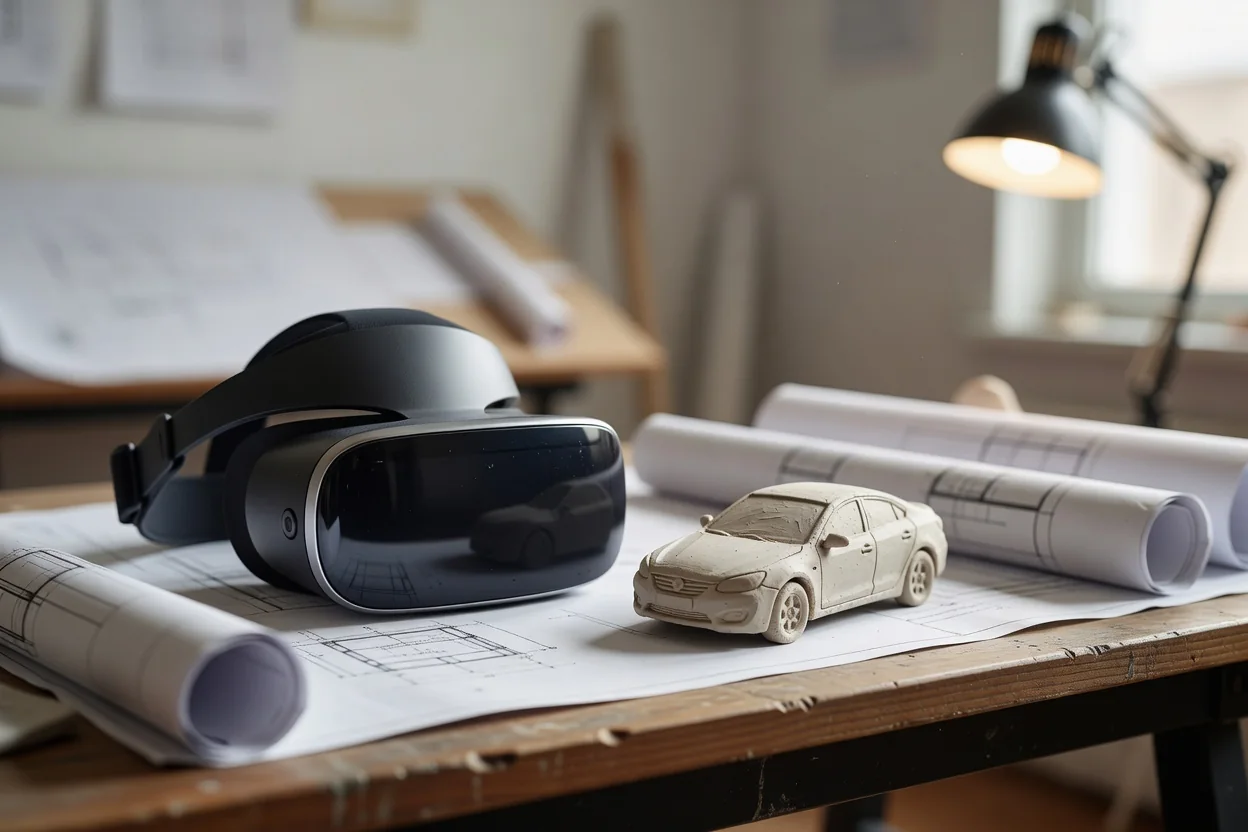
Virtual reality forces product teams to confront real human dimensions at the earliest stages. A control panel that looks balanced on a monitor often feels cramped once an engineer stands inside the digital cockpit at 1:1 scale. Ford designers using Gravity Sketch since 2019 routinely discover reach issues and blind spots during the first collaborative session, long before any hardware leaves the clay room. The cost of fixing these problems drops dramatically when they are caught in VR instead of after a physical prototype has been built.
Ergonomics reviews in Autodesk VRED let multiple evaluators of different heights and arm lengths test the same interior layout in one 30-minute meeting. The software records each user’s eye height and reach data automatically, generating heat maps that highlight awkward zones. This data-driven approach has helped reduce late-stage redesigns at several European OEMs, although exact savings vary by program.
ShapesXR for Rapid Interface Prototyping
ShapesXR lets teams prototype 3D interfaces and scenes directly inside headsets, eliminating the round-trip between desktop tools and immersive testing. Designers sketch interactive buttons, gesture controls, and spatial menus at actual size, then hand the prototype to engineers for immediate usability feedback. A single ShapesXR session can replace days of desktop modeling and screen-based reviews, compressing the iteration loop for automotive human-machine interfaces.
The tool’s real-time synchronization supports multi-site review sessions where a UI designer in Munich and a hardware engineer in Detroit manipulate the same virtual dashboard simultaneously. Changes appear instantly for both participants, preserving context that email screenshots destroy. Because the prototype lives inside the headset, stakeholders experience motion, depth, and field-of-view constraints that flat diagrams cannot convey.
Model Preparation Effort Remains a Bottleneck
High-fidelity VR reviews still demand significant model-prep effort. CAD assemblies from CATIA or Creo must be decimated, materials reassigned, and lighting rigs rebuilt inside Autodesk VRED before a review can begin. Automotive teams report spending many hours preparing a single vehicle model for a one-hour design review, a hidden cost that offsets some of the savings versus clay models. The Wild’s integration into Autodesk’s AEC toolchain has streamlined architectural model handoff, yet product teams outside building design still wrestle with manual cleanup steps.
Multi-Site Collaboration Changes Meeting Dynamics
Multi-site review sessions using The Wild or Autodesk VRED collapse geographic distance. A styling director in California, an ergonomics specialist in Germany, and a manufacturing engineer in Mexico can occupy the same virtual studio, point at the same surface, and record annotations that persist across time zones. Voice chat, laser pointers, and shared measurement tools make the conversation feel colocated even though participants never leave their desks. The format reduces jet lag and hotel expenses while increasing the number of stakeholders who can contribute without travel approval.
Review Recordings Become Design References
Session recordings serve as living references long after the meeting ends. Reviewers replay exact camera paths, listen to earlier comments, and compare annotations across design iterations. This persistent record has proven especially valuable during regulatory audits and supplier handoffs where visual evidence of decisions carries more weight than meeting minutes.
- Ford designers have used Gravity Sketch since 2019 to sketch cars in 3D collaboratively.
- Autodesk VRED is the standard automotive visualization tool used by carmakers for virtual design reviews.
- ShapesXR lets teams prototype 3D interfaces and scenes directly inside headsets.
- The Wild acquired IrisVR in 2021 and was itself acquired by Autodesk in 2022.
- VR catches scale and ergonomics problems before physical prototypes are built.
- One full-size clay model still costs hundreds of thousands of dollars.
| Phase | Traditional Method | VR Method | Typical Time Saved |
|---|---|---|---|
| Concept Sketch | 2D drawings | Gravity Sketch | 3 weeks |
| Design Review | Clay model | Autodesk VRED | 4 weeks |
| Interface Prototype | Desktop 3D | ShapesXR | 2 days |
| Multi-Site Feedback | Travel | The Wild | 5 days |
| Model Prep | Minimal | CAD cleanup | -15 hours |
VR prototyping and design review deliver clear advantages in speed and early problem detection, yet the upfront model-prep effort and hardware requirements mean the technology complements rather than fully replaces traditional methods. Teams that invest in clean CAD pipelines and standardized review templates see the largest returns. As headset comfort improves and integration with existing CAD tools deepens, more product and architecture groups will adopt these workflows, but the transition still demands deliberate process change.